
How to Choose Active Ingredients for a Skincare Formula
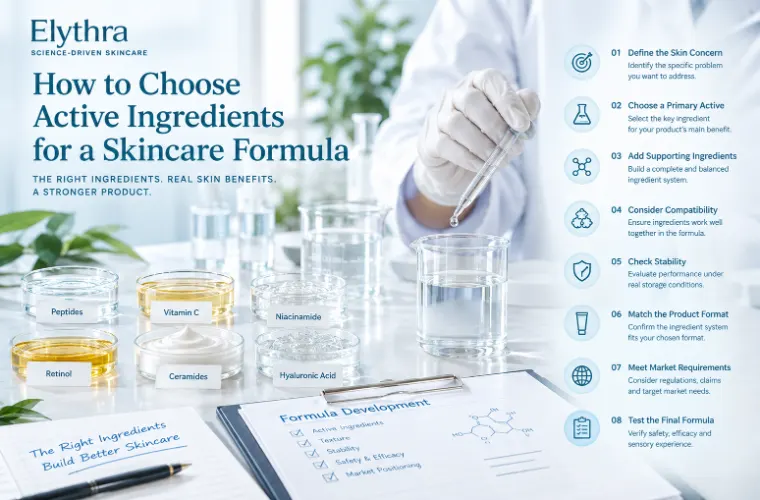
Choosing active ingredients is one of the most important decisions in skincare product development.
An ingredient should not be selected simply because it is trending or widely recognized by consumers.
For a commercial skincare product, the development team needs to consider the ingredient’s intended function, compatibility with the formula, target consumer, product format, stability and market positioning.
01 Start With the Product Objective
Before selecting ingredients, define the product’s primary purpose.
Examples include:
- Brightening
- Anti-aging
- Firming
- Acne care
- Barrier support
- Hydration
- Post-procedure recovery
- Hair and scalp care
A clear product objective makes ingredient selection more focused.
02 Choose a Primary Active
A formula usually needs a clear functional direction.
Brightening
Possible active systems may include vitamin C, niacinamide or other brightening-oriented ingredients.
Anti-Aging
Peptides and retinoid-based systems are commonly considered for anti-aging product concepts.
Barrier Support
Ceramides, panthenol and other conditioning ingredients can form part of a barrier-focused formulation strategy.
Acne Care
Salicylic acid and other ingredients may be considered depending on the product concept and target market.
The objective is not to add as many active ingredients as possible.
The objective is to build a coherent formula.
03 Build a Supporting Ingredient System
A primary active rarely works alone. A well-designed formula may combine:
This creates a complete product rather than simply an ingredient list.
04 Consider Ingredient Compatibility
Not every ingredient combination is suitable.
The formulation team may need to evaluate:
- pH
- Solubility
- Concentration
- Compatibility
- Processing conditions
- Stability
- Packaging
- Sensory characteristics
This is where formulation expertise becomes important.
05 Consider Stability
Some active ingredients require careful handling because their performance can be affected by environmental or formulation conditions.
Development may therefore include:
- Stability evaluation
- Packaging compatibility
- Appearance monitoring
- pH monitoring
- Texture evaluation
The finished formula needs to remain consistent throughout its intended shelf life. The testing programme behind this is covered in skincare stability testing.
06 Consider the Product Format
An ingredient system suitable for a serum may not automatically be suitable for a cleanser or cream.
The formulation strategy should consider whether the ingredient can perform appropriately within the chosen product format.
This is another reason why ingredient selection and product format selection should happen together.
07 Consider Your Target Market
Ingredient selection also needs to consider the intended market.
Brands may need to evaluate:
- Local regulatory requirements
- Ingredient restrictions
- Product claims
- Labeling requirements
- Consumer expectations
Market requirements should be considered before finalizing the formula rather than after development is complete.
08 Avoid “Ingredient Overload”
More ingredients do not automatically create a better product.
A formula containing many trendy ingredients may become unnecessarily complicated.
A stronger approach is often:
This creates a more understandable product proposition for both the brand and the consumer.
09 From Ingredient Selection to Finished Product
Professional formulation development connects:
The ingredient list is only one part of the product development process.
Final Thoughts
The right active ingredient is not necessarily the newest or most popular ingredient.
It is the ingredient that makes sense for the product objective, formula architecture, target market and commercial positioning.
If you are still defining the product concept, start with how to prepare a skincare product brief and benchmark-based product development; if the formula direction is set, the next step is stability testing and microbial testing.
Ready to Develop Your Skincare Line?
Share your product concept, target market and estimated quantity. Our team reviews your brief and comes back with a formulation and production proposal.