
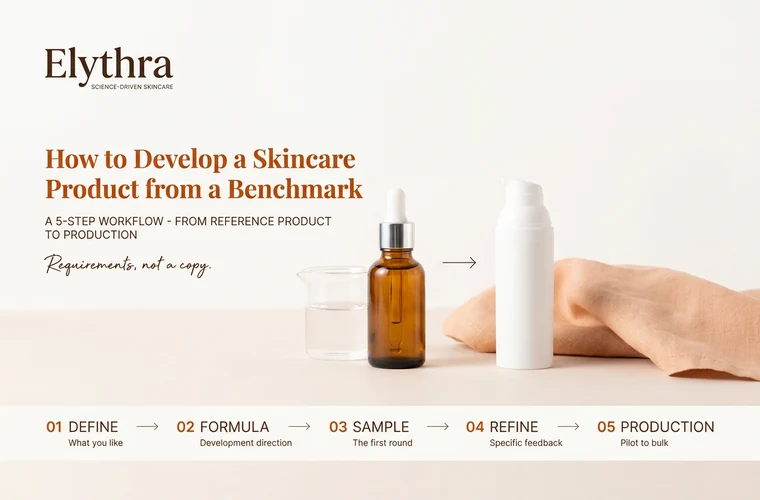
How to Develop a Skincare Product from a Benchmark: A 5-Step Workflow
Many skincare brands do not start with a completely new product idea.
They may already have a reference product – a texture, a finish, a packaging format or a product concept they want to use as a starting point.
A benchmark can make product development more efficient. But the goal should not be to copy another product. The goal is to understand what works about the reference and translate those requirements into a formula that fits your own brand.
This guide covers the five practical steps of benchmark-based development, from defining what you like through to production. If you are still shaping the concept itself, start with how to prepare a skincare product brief and the complete guide to skincare OEM/ODM manufacturing.
01 Define What You Like About the Benchmark
Start by identifying the characteristics that matter most:
- Product format
- Texture
- Absorption
- Finish
- Fragrance
- Packaging
- Active ingredients
- Target skin concern
- Target market
- Target price
The more specific the brief, the easier it is for an R&D team to understand the direction.
A useful way to frame this is:
“We are not asking for a copy of this product. We are asking for these specific characteristics.”
That single sentence prevents a large share of later misunderstandings – and it connects directly to the product development timeline that follows.
02 Analyze the Formula Direction
An OEM/ODM manufacturer can review the available ingredient information and determine a suitable formulation direction.
The objective is not necessarily to reproduce the exact ingredient list.
Instead, the development team needs to consider:
Where the benchmark’s active system is protected or unclear, the practical route is usually to keep the same function rather than the same ingredient list – a decision better handled as part of choosing the active ingredients for a skincare formula.
03 Develop the First Sample
The first sample translates the benchmark into a practical product.
At this stage, brands should evaluate:
- Texture
- Spreadability
- Absorption
- Skin feel
- Appearance
- Odor
- Packaging compatibility
It helps to record the evaluation against the brief rather than against memory – the same discipline described in the skincare sample approval checklist.
04 Refine the Formula
The best feedback is specific.
Instead of saying:
“Make it better.”
Try:
“Reduce tackiness after application.”
or:
“Make the texture lighter and faster absorbing.”
This gives the R&D team a clear direction for the next sample – and it keeps the revision count down.
05 Move From Sample to Production
Once the formula, packaging and specifications are approved, the project can move toward pilot production and mass production.
A benchmark therefore becomes more than a reference product. It becomes a practical development tool that helps the brand communicate its expectations.
What Should You Send Your OEM Partner?
A useful benchmark brief can include:
None of these items requires a finished technical brief. They simply let your partner judge feasibility, MOQ and cost before development starts. Our transdermal delivery solutions and product portfolio pages show the range of formats this workflow can target.
Final Thoughts
A benchmark is most useful when it describes requirements, not a wish to reproduce someone else’s product.
If you already have a reference product in hand, you can send the details and request a project-specific quote. To see the wider picture first, read how benchmark development fits into an OEM/ODM project and our OEM/ODM services.
Ready to Develop Your Skincare Line?
Share your product concept, target market and estimated quantity. Our team reviews your brief and comes back with a formulation and production proposal.