How Much Does It Cost to Develop a Skincare Product?
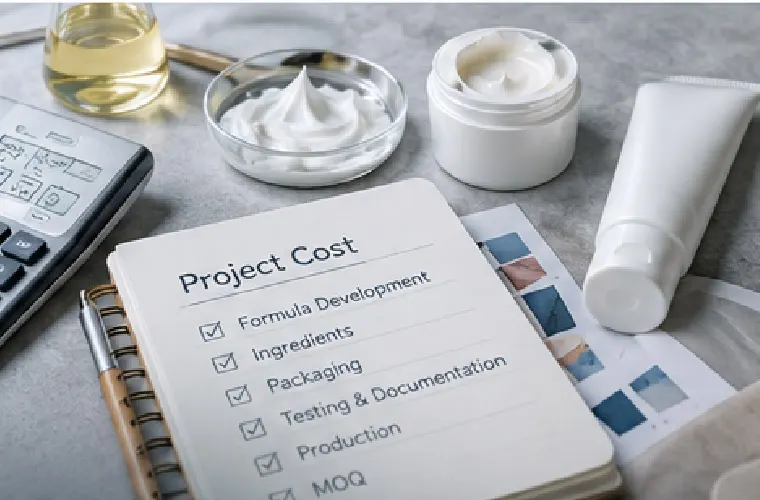
One of the first questions many beauty brands ask is:
How much does it cost to develop a skincare product?
The challenge is that there is no single price that applies to every skincare project.
A basic private-label serum and a highly customized treatment product can have very different cost structures.
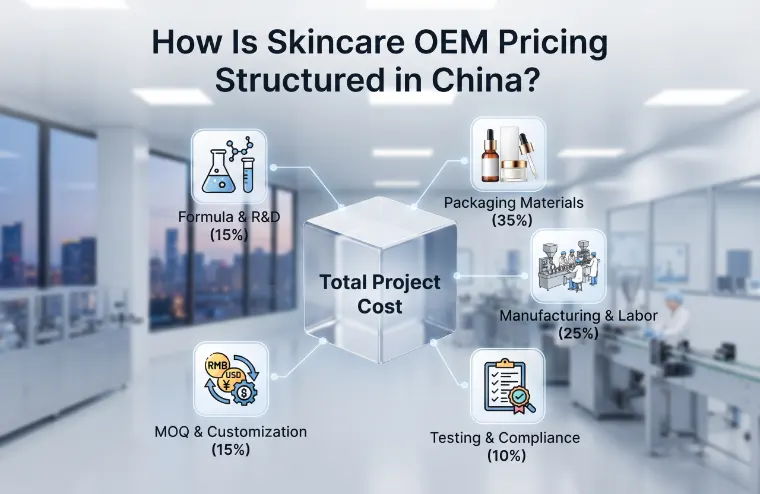
The total project cost may involve:
This guide explains the main factors that influence skincare product development cost.
What Determines Skincare Product Development Cost?
The most important factors include:
- Formula development
- Product format
- Ingredient selection
- Packaging
- Testing
- Customization
- MOQ
- Production quantity
- Documentation
- Market requirements
Understanding these factors is more useful than looking for a single “average skincare product price.”
1. Formula Development
The starting point has a major effect on development cost.
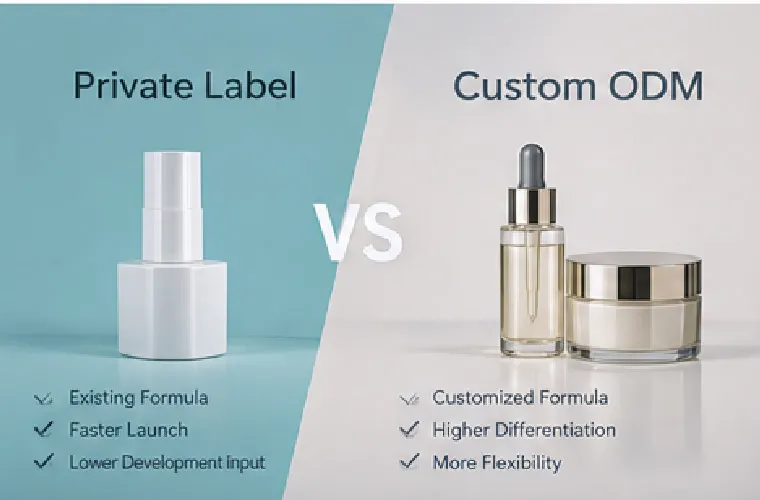
Existing Formula
If you start from an established formula concept, the project may require less development work.
This can be suitable for:
- New brands
- Market testing
- Faster launches
- Private label products
Customized Formula
A customized formula may require:
- Ingredient selection
- Texture development
- Multiple sample rounds
- Stability evaluation
- Benchmark development
- Additional testing
The more customized the product, the more development work may be required. The difference between the two starting points is compared in our private label vs custom ODM guide.
2. Ingredients
Ingredients can influence cost in several ways.
The cost may depend on:
- Ingredient type
- Concentration
- Supplier
- Minimum purchasing quantity
- Availability
- Stability requirements
- Formula complexity
However, an expensive ingredient does not automatically make a product commercially better.
A stronger development process considers:
3. Product Format
A serum, cream, cleanser, mask and shampoo may have very different production requirements.
For example:
Serum
may require a dropper, pump or specialty bottle.
Cream
may require a jar or tube.
Shampoo
requires packaging suitable for a larger-volume liquid product.
Mask
may involve sheet, cream or specialty mask formats.
The product format therefore affects both formula and packaging costs.
4. Packaging
Packaging can represent an important part of the total project budget.
Costs may come from:
- Bottle
- Jar
- Tube
- Pump
- Dropper
- Cap
- Label
- Box
- Decoration
- Printing
- Custom tooling
Standard packaging can simplify a project.
Custom packaging can create more differentiation but may require greater upfront commitment.
5. Testing
Testing requirements depend on the product and intended market.
Potential testing areas can include:
- Stability
- Microbiological quality
- Packaging compatibility
- Safety-related evaluations
- Product performance
- Other market-specific testing
A project requiring more extensive testing will naturally have a different development cost structure from a straightforward established formula project.
6. Customization
Every additional customization can affect the project.
Examples include:
Formula
New ingredient system or texture
Packaging
Custom bottle or component
Product Experience
Special sensory characteristics
Product Positioning
Specialized product concept
Benchmark
Development based on an existing product
Customization can create greater differentiation, but it also increases development complexity.
7. MOQ
Production quantity has a major effect on unit economics. How MOQ is determined in the first place is explained in our skincare OEM MOQ guide.
A small production run may have higher unit costs because setup and production costs are spread across fewer units.
Larger production runs can change the cost structure.
Therefore, when comparing manufacturer quotes, do not only compare:
Price per unit
Also compare:
MOQ + Packaging + Formula + Testing + Total Project Cost
Private Label vs Custom ODM Cost Structure
The difference can be summarized like this:
| Factor | Private Label | Custom ODM |
|---|---|---|
| Starting Formula | Established | Customized |
| Development Work | Lower | Higher |
| Customization | Selected | Higher |
| Sampling | Usually simpler | Potentially more rounds |
| Packaging | Standard or selected custom | More customizable |
| Initial Complexity | Lower | Higher |
| Product Differentiation | Moderate | Higher potential |
This does not mean private label is always less expensive overall or ODM is always more expensive.
The final cost depends on the actual project scope. Both models sit inside the same wider development process, which is outlined in our complete guide to skincare OEM/ODM manufacturing.
Why Two Similar Skincare Products Can Have Different Costs
Two products may look almost identical but still have different production costs.
For example, two brightening serums can differ in:
- Active ingredients
- Ingredient concentrations
- Packaging
- Bottle material
- Filling requirements
- Testing
- MOQ
- Customization
- Product positioning
This is why a meaningful cost comparison needs the full project specifications.
How to Estimate Your Project Cost Before Development
Prepare these details:
- Product Format
- Target Quantity
- Target Market
- Formula Direction
- Preferred Ingredients
- Packaging Preference
- Customization Requirements
- Target Launch Date
- Benchmark Product
The more complete the project brief, the more accurately an OEM/ODM manufacturer can evaluate the project.
What Should You Ask for in a Skincare OEM Quote?
Do not only ask:
“What is the unit price?”
Ask for a quotation structure that makes clear:
- Formula / Development
- Sampling
- Testing
- Packaging
- Production
- MOQ
- Additional Services
- Lead Time
This helps you compare suppliers on the same basis. The same principle applies when comparing skincare OEM manufacturers in China.
Why a Lower Unit Price Is Not Always the Lowest Project Cost
Suppose one supplier offers a lower unit price but requires:
- Larger MOQ
- More expensive packaging
- Additional development fees
- Longer lead time
Another supplier may have a slightly higher unit cost but a better overall project structure.
Therefore, brands should compare:
Total Project Economics
rather than a single number.
How Elythra Beauty Approaches Product Costing
Elythra Beauty evaluates product projects based on the actual development requirements.
Depending on the project, the starting point may be:
The project can then be evaluated around:
This allows the quotation to reflect the actual project rather than relying on a generic product price.
Final Takeaway
There is no universal cost for developing a skincare product.
The final project economics depend on:
- Formula
- Packaging
- Customization
- Testing
- MOQ
- Production Quantity
- Market Requirements
For that reason, the best way to understand your expected cost is to prepare a complete product brief and request a project-specific quotation.
Ready to Develop Your Skincare Line?
Share your product concept, target market and estimated quantity. Our team reviews your brief and comes back with a formulation and production proposal.