
How to Choose a Skincare OEM Manufacturer in China
China has a large and diverse cosmetics manufacturing ecosystem, but that also means choosing the right supplier requires careful evaluation.
A manufacturer may have good production capacity but limited R&D.
Another may have strong formulation capabilities but less flexible packaging support.
Another may offer a competitive price but not provide the project management or documentation your brand requires.
For overseas beauty brands, the right supplier should therefore be evaluated as a product-development and manufacturing partner, not simply as a low-cost factory.
What Should You Check Before Choosing a Chinese Skincare Manufacturer?
The most important areas include:
1. Evaluate R&D and Formulation Capability
A skincare manufacturer should be able to explain how it approaches formulation development.
Ask:
- Do you have an in-house R&D team?
- Can you customize formulas?
- Do you support benchmark development?
- Can you modify texture?
- Can you work with specific active ingredients?
- How many sample rounds are included?
- How are formula changes documented?
A manufacturer that only provides a product catalog may not be the right partner for a project requiring significant customization. The development models a manufacturer can support are compared in our private label vs custom ODM guide.
2. Evaluate Manufacturing Capability
Ask what the manufacturer can actually produce.
Review:
- Manufacturing facility
- Production lines
- Product formats
- Production capacity
- Filling capability
- Packaging capability
- Pilot production
- Mass production
Do not judge manufacturing capability based only on factory size.
The more important question is:
Can the factory consistently produce the type of product your brand needs?
3. Review Quality Control
Quality control should cover more than finished-product inspection.
Ask about:
Raw Materials
How are incoming materials checked?
Production
How is batch production monitored?
Filling
How are filling and packaging processes controlled?
Finished Products
What checks are performed before release?
Traceability
Can production batches be traced back to relevant records?
These questions help you understand whether quality is part of the manufacturing system rather than simply a final inspection.
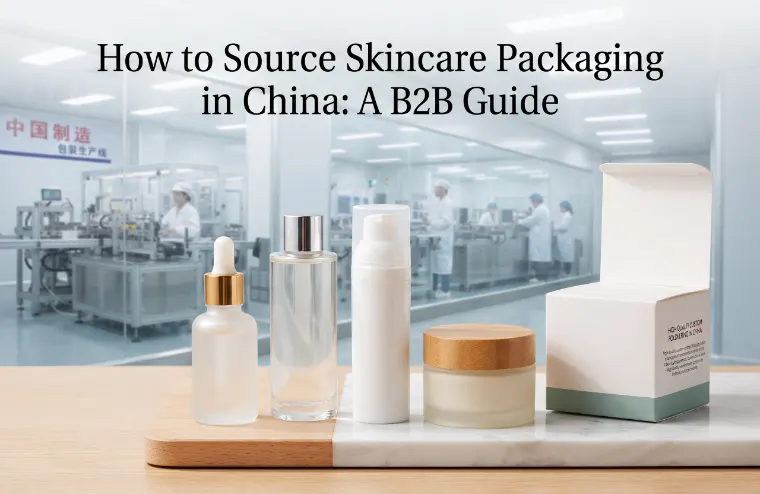
4. Evaluate Packaging Support
A skincare project involves both formula and packaging.
Ask whether the manufacturer can support:
- Bottles
- Jars
- Tubes
- Pumps
- Droppers
- Boxes
- Labels
- Custom components
- Packaging artwork coordination
A supplier that can coordinate packaging together with formula production can simplify communication.
5. Understand MOQ
Do not compare manufacturers only by the lowest MOQ.
Ask:
- Is the MOQ based on the formula or finished product?
- Does packaging have a separate MOQ?
- Does customization change the MOQ?
- Can a new brand start with a smaller production run?
- Does the MOQ change for reorders?
A good MOQ structure should fit your launch strategy. How MOQ is calculated, and why it differs between projects, is explained in our skincare OEM MOQ guide.
6. Evaluate Communication
Communication is especially important when working internationally.
Pay attention to:
- Response speed
- Technical understanding
- English communication
- Documentation quality
- Project tracking
- Sample feedback
- Change management
A low production price does not compensate for poor project communication if misunderstandings cause repeated sample revisions or production delays.
7. Review Documentation
Depending on the project and target market, you may need documentation relating to:
- Product specifications
- Ingredients
- Testing
- Quality control
- Packaging
- Production
- Market requirements
The exact documents required depend on the product, destination market and project structure.
Ask your supplier:
What documentation can you provide for this specific product?
Do not assume that a standard document package applies to every product.
8. Consider Your Target Market
A manufacturer should understand that product development requirements differ between markets.
For example, a brand targeting:
Discuss the target market before the formula and packaging are finalized.
This can help ensure that market-related considerations are addressed earlier in the development process. For example, our guide to developing a skincare product for the U.S. market covers the requirements that most often affect formulation and labeling.
9. Ask About Benchmark Development
If you already have a successful product you want to reference, ask whether the manufacturer can support benchmark development.
You may be able to provide:
- Product sample
- Ingredient list
- Product photographs
- Packaging references
- Texture description
- Product positioning
A benchmark should be treated as a development reference, not simply as a request to copy an existing product without evaluating formulation feasibility or applicable requirements.
10. Evaluate Scalability
A supplier may be able to support your first small production run.
But what happens when your product grows?
Ask:
- Can you support larger production volumes later?
- Can the same formula be maintained across larger batches?
- Can packaging supply scale with production?
- Can quality-control procedures support increased volume?
Choosing a supplier only for the first order can create problems if you need to change manufacturers when demand grows.
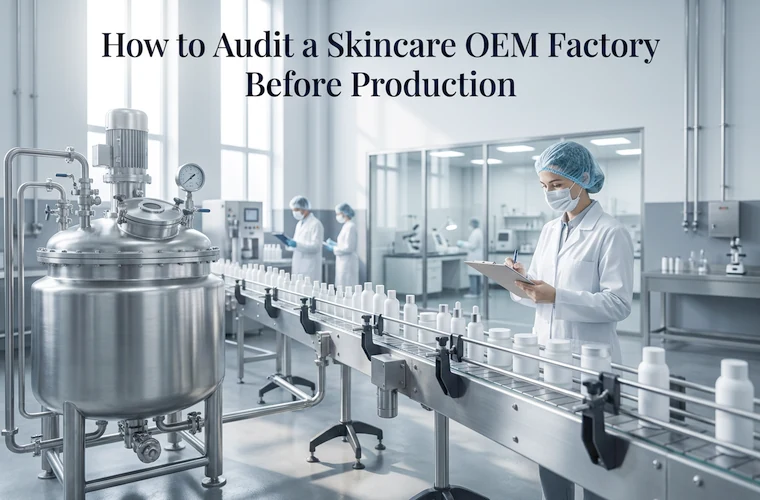
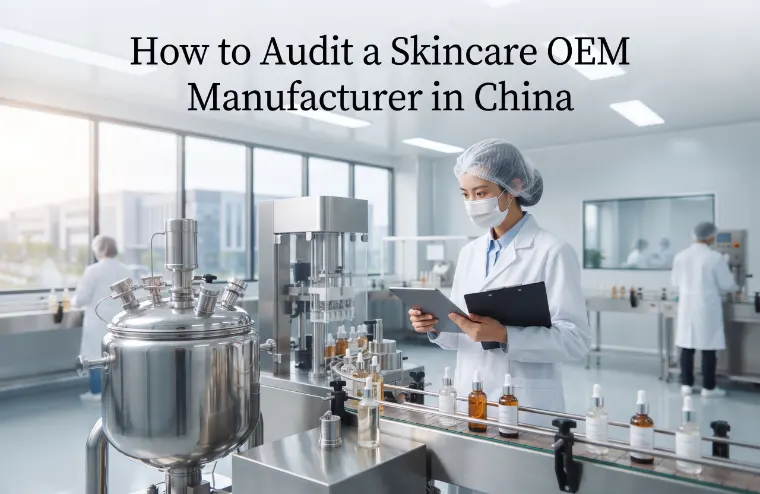
How to Audit a Skincare OEM Manufacturer
Before placing a significant order, create a simple supplier evaluation checklist.
Company
- Company information
- Manufacturing location
- Business structure
R&D
- Formula development
- Sample process
- Benchmark development
Manufacturing
- Production lines
- Product formats
- Capacity
Quality
- Raw-material control
- Production control
- Finished-product inspection
- Traceability
Packaging
- Packaging sourcing
- Custom components
- Artwork coordination
Commercial
- MOQ
- Pricing structure
- Lead time
Market
- Documentation
- Target-market support
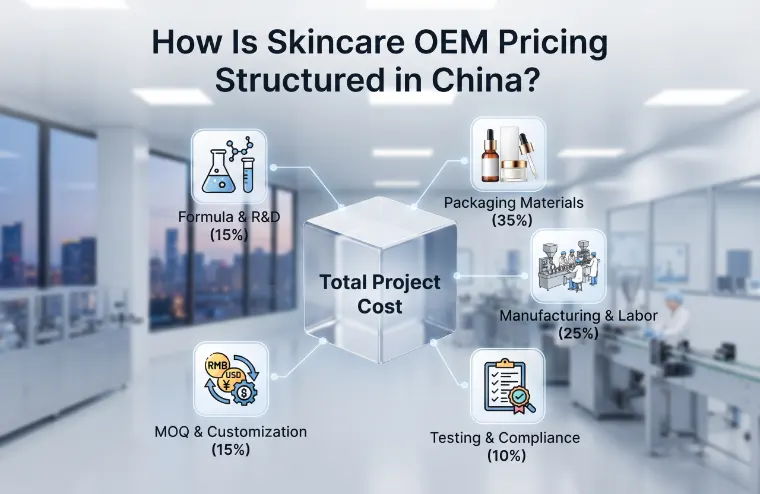
This gives you a more balanced view than comparing unit prices alone. The same logic applies to project economics more broadly – see our skincare product development cost guide.
Common Mistakes When Choosing a China Skincare OEM
What Information Should You Request From a Manufacturer?
Before making a decision, ask for information covering:
- Company
- R&D
- Manufacturing
- Quality
- Packaging
- MOQ
- Lead Time
- Documentation
- Market Support
- Sample Process
This makes supplier comparison much more structured.
How Elythra Beauty Supports Overseas Brands
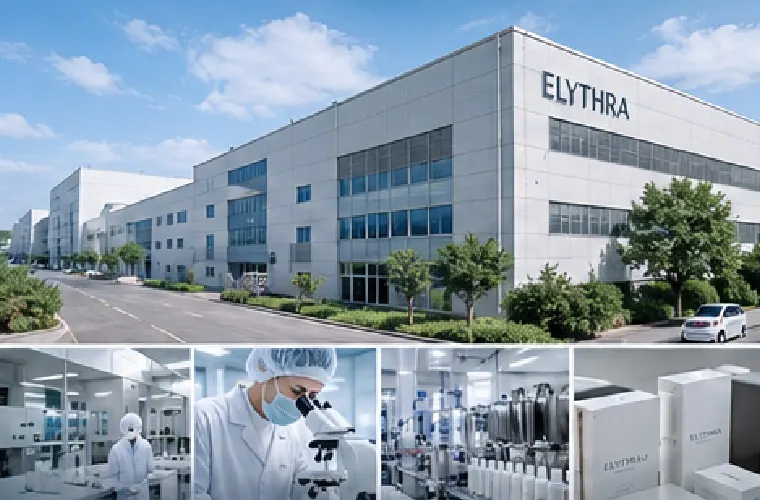
Elythra Beauty is based in Guangzhou, China and works with global beauty brands on functional skincare product development and OEM/ODM manufacturing.
Our product development model combines:
The current portfolio includes 400 mature formulas across 6 solution categories, allowing brands to start from an established product concept or build a broader product line around specific skincare needs.
For customized projects, the development process can be adapted around the brand’s product concept, target market, formulation requirements and packaging strategy.
Final Takeaway
Choosing a skincare OEM manufacturer in China should not be a price-comparison exercise.
A strong supplier evaluation looks at the complete picture:
The right manufacturing partner should be able to support not only your first production run, but also the development and growth of your product line. You can review our OEM/ODM development approach or request a project-specific quote.
Ready to Develop Your Skincare Line?
Share your product concept, target market and estimated quantity. Our team reviews your brief and comes back with a formulation and production proposal.