
Private Label vs Custom ODM: Which Is Right for Your Brand?
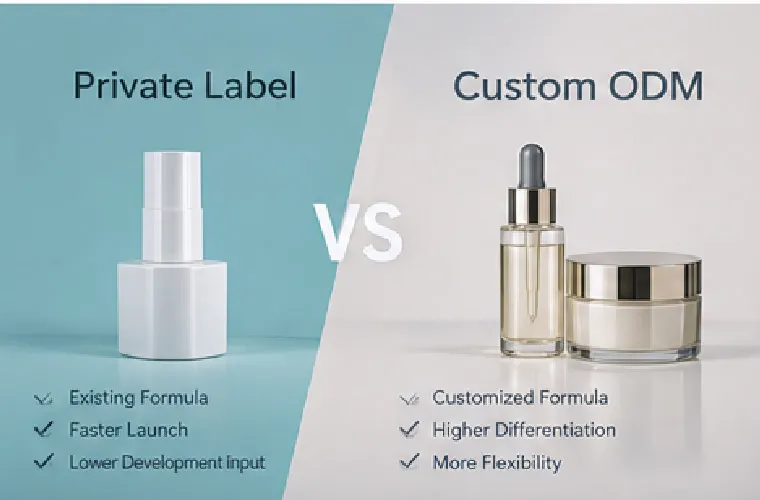
When developing a skincare product, brands often choose between two broad approaches:
Both models can work well, but they serve different product-development strategies.
The right choice depends on how much customization you need, how quickly you want to launch and how much input you want in the formulation and product-development process.
What Is Private Label Skincare?
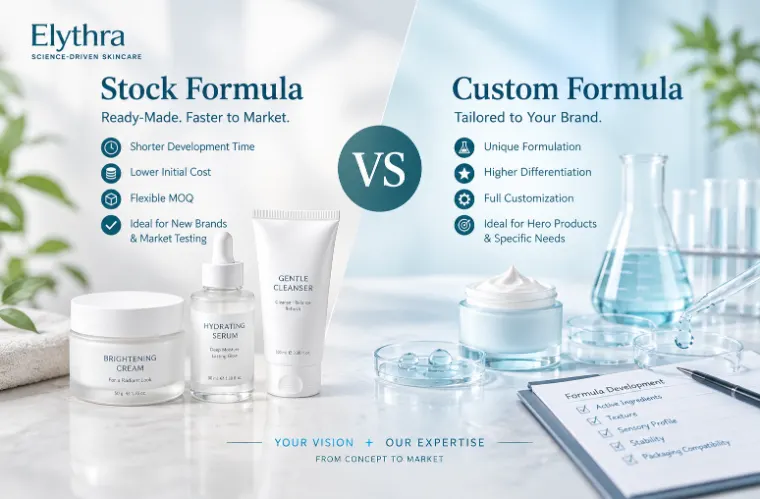
Private label generally starts with an established formula.
The manufacturer already has a product concept or formula that can serve as the starting point.
The brand can then customize areas such as:
- Branding
- Packaging
- Product presentation
- Labeling
- Selected product specifications
Private label is often suitable for brands that want a simpler route into the market. Its cost structure and starting quantities are covered in our skincare OEM MOQ guide.
What Is Custom ODM?
Custom ODM involves deeper product development.
The brand and manufacturer work together around requirements such as:
- Formula
- Active ingredients
- Texture
- Sensory profile
- Product format
- Product positioning
- Benchmark
- Packaging
The product can therefore be developed more specifically around the brand’s concept. Where that development work sits in the overall process is set out in our complete guide to skincare OEM/ODM manufacturing.
Private Label vs Custom ODM
| Factor | Private Label | Custom ODM |
|---|---|---|
| Starting Point | Established formula | New or customized formula |
| Formula Customization | Limited / Selected | Higher |
| Development Time | Generally faster | Generally longer |
| Brand Input | Lower | Higher |
| Product Differentiation | Moderate | Higher potential |
| Development Complexity | Lower | Higher |
| Best For | New launches / testing | Specific product concepts |
| Benchmark Development | Limited / optional | Common project route |
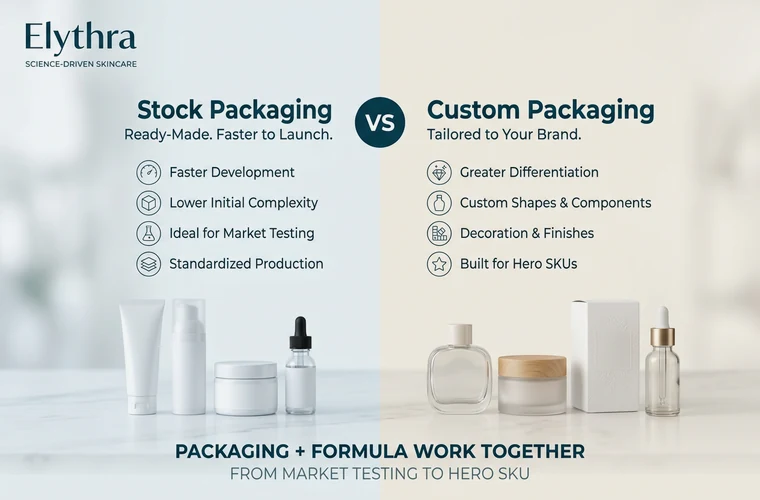
| Packaging | Standard or selected options | Higher flexibility |
| Product Line Strategy | Faster launch | More differentiated portfolio |
When Does Private Label Make Sense?
Private label can be useful when:
You Are Launching Your First Product
You may not yet need to invest heavily in formula development.
You Want to Test the Market
A focused first product can help evaluate product-market fit.
Speed Matters
An established formula can reduce some of the early development work.
You Have a Smaller Initial Project
Selected established formulas may support more flexible production quantities.
You Already Know Your Product Format
You may simply need the right formula, packaging and branding.
When Does Custom ODM Make Sense?
Custom ODM can be more appropriate when:
You Need a Differentiated Formula
Your product needs a specific active system or sensory profile.
You Have a Strong Product Concept
You already know what you want to create.
You Have a Benchmark Product
You want to develop a product based on a reference sample or existing product concept.
You Have Specific Target Consumers
The product must be designed around a very specific consumer or channel.
You Are Building a Long-Term Product Line
You want stronger control over your product architecture and positioning.
Is Private Label Always Faster?
Not necessarily.
Private label can provide a faster starting point because the formula already exists, but actual launch timing still depends on:
- Packaging
- Artwork
- Sampling
- Testing
- Production schedule
- Documentation
- Market requirements
Custom ODM can take longer because the formula itself may require development and refinement.
The actual timeline should therefore be confirmed based on the complete project.
Can Private Label Be Customized?
Yes, depending on the product.
An established formula may still allow selected adjustments, such as:
- Texture
- Fragrance
- Packaging
- Product presentation
- Selected ingredients
The level of available customization depends on the specific formula and its technical requirements.
It is useful to ask the manufacturer:
What can be customized without turning the project into a completely new formulation?
Can You Start With Private Label and Move to ODM Later?
Yes.
This can be a practical product-development path.
For example:
This approach can allow a brand to learn from its initial market experience before investing in deeper product development. Because the cost drivers differ between the two stages, it is worth reviewing our skincare product development cost guide before scaling up.
Private Label vs Custom ODM for Product Lines
The decision becomes more interesting when you are launching several products.
For example, a brand could start with:
Private Label
And later develop:
Custom ODM
This creates a hybrid product strategy.
There is no requirement to use the same development model for every SKU.
How Should You Choose?
Ask yourself these questions:
Do you need to launch quickly?
Consider an established formula.
Do you need a highly differentiated product?
Consider custom ODM.
Are you testing a new market?
A private-label starting point may reduce initial development complexity.
Do you already have a benchmark?
Custom development may be more appropriate.
Are you developing a long-term hero product?
Custom ODM may provide greater control over the final product concept. If the target market is the United States, market-specific requirements should also be part of that decision – see our U.S. market development guide.
How Elythra Beauty Supports Both Models
Elythra Beauty offers both:
Private Label
Start with selected established formulas and customize branding, packaging and other available specifications.
Custom ODM
Develop products around specific formula, ingredient, texture, positioning and market requirements.
The two approaches can also be combined across the same product portfolio.
For example:
This can help brands balance launch speed and product differentiation.
Final Takeaway
Private Label and Custom ODM are not competing concepts.
They are two different product-development paths.
The right choice depends on:
- Speed
- Customization
- Product Differentiation
- Budget
- Market Strategy
- Long-Term Brand Plans
A good OEM/ODM partner should be able to discuss both options and help define the appropriate development path for each product. Both models are supported within our OEM/ODM development services, and you can request a quote for a specific product.
Ready to Develop Your Skincare Line?
Share your product concept, target market and estimated quantity. Our team reviews your brief and comes back with a formulation and production proposal.