
How to Prepare a Skincare Product Brief for an OEM Manufacturer

A good product brief can save significant time during skincare development.
Without a clear brief, an OEM manufacturer may need to ask multiple questions before understanding what you actually want to create.
With a clear brief, the manufacturer can evaluate:
- Formula direction
- Product format
- Packaging
- MOQ
- Development complexity
- Target market
- Production requirements
The product brief does not need to be extremely long.
It needs to be clear, specific and commercially useful.
What Should a Skincare Product Brief Include?
A practical product brief can include:
Let’s look at each one.
1. Product Concept
Start with one clear sentence.
Weak:
“I need a good serum.”
Better:
“We want to develop a lightweight brightening serum for a premium DTC skincare brand.”
Even better:
“We want to develop a lightweight brightening serum for a premium DTC brand targeting consumers concerned about uneven-looking skin tone, with a fast-absorbing texture suitable for daily use.”
A clear concept helps the R&D team understand the intended direction.
2. Target Consumer
Define who the product is for.
Consider:
- Age range
- Gender, if relevant
- Skin concerns
- Product expectations
- Price positioning
- Consumer channel
You do not need to define every detail.
The goal is to establish the product’s commercial context.
3. Target Market
This should be included from the beginning.
For example:
Different markets may have different requirements relating to ingredients, labeling, claims and documentation.
Defining the market early helps avoid late-stage changes. Our guide to developing a skincare product for the US market shows how market requirements shape the brief.
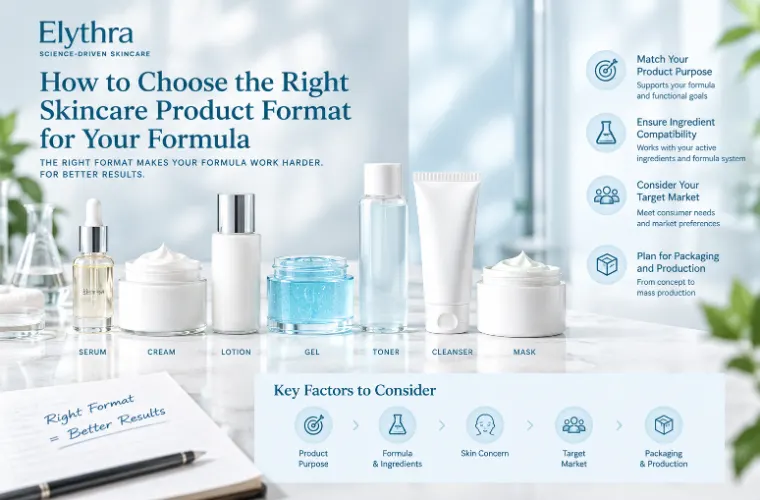
4. Product Format
Specify the format whenever possible.
Examples:
- Serum
- Cream
- Lotion
- Cleanser
- Mask
- Shampoo
- Ampoule
- Facial oil
Packaging and formulation development depend partly on the product format. The trade-offs between formats are covered in serum vs cream for functional skincare.
5. Main Product Concern
Describe what the product is intended to address.
Examples:
- Brightening
- Firming
- Barrier-focused care
- Acne-prone skin care
- Hair and scalp care
- Daily cleansing
- Post-procedure care
Keep the wording appropriate to the intended cosmetic positioning and target market.
6. Preferred Ingredients
You can list ingredients you are interested in.
For example:
However, avoid treating your preferred ingredient list as a complete formula.
The formulator may recommend:
- Different concentrations
- Different ingredient forms
- Supporting ingredients
- Alternative systems
Ingredient preferences are a starting point for formulation discussion.
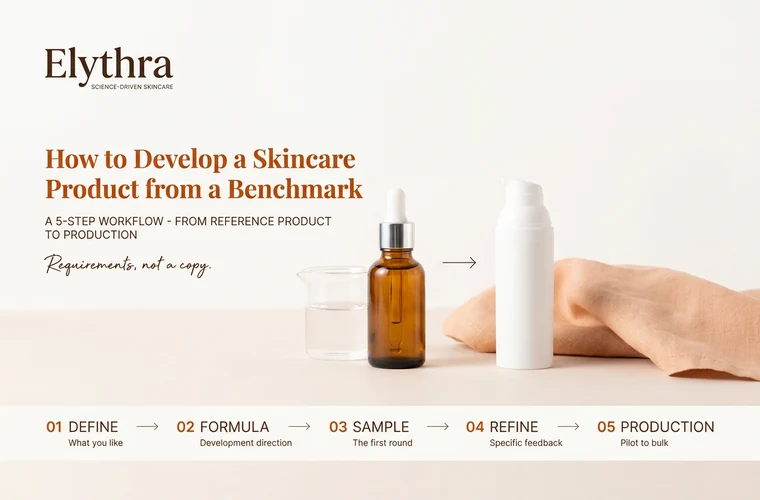
7. Benchmark Product
This can be one of the most useful elements of the brief.
Provide:
- Product name
- Brand
- Product photos
- Physical sample, if available
- Ingredient list
- Texture description
- Packaging reference
Also describe what you like about the benchmark.
For example:
“We like the lightweight texture and quick absorption, but want a more premium sensory finish.”
That is far more useful than simply saying:
“Make it similar.”
How a benchmark is actually evaluated is explained in how to develop a skincare product from a benchmark.
8. Texture and Sensory Expectations
Describe the desired experience.
For example:
The clearer the sensory direction, the easier it is for the development team to evaluate samples against the intended experience.
9. Packaging
You do not necessarily need to know the exact package at the beginning.
But provide your preferences:
- Dropper
- Pump
- Tube
- Jar
- Bottle
- Airless
- Sachet
Also specify whether you want standard packaging or custom packaging.
Packaging requirements can affect MOQ and project timing. The full comparison is in how to choose skincare packaging.
10. MOQ
Provide an estimated range if you have one.
For example:
Initial order: 1,000–3,000 units
or:
We want to test the market with the lowest feasible production quantity.
This allows the manufacturer to suggest a suitable development route. If MOQ is a concern for a first launch, see our complete guide to skincare OEM MOQ.
11. Target Price
A target price range can help determine whether your desired product positioning is commercially realistic.
For example:
Target ex-factory price: $4–$6 per unit
The exact quotation still depends on:
- Formula
- Packaging
- Quantity
- Testing
- Customization
- Other project requirements
How these variables are priced is explained in how skincare OEM pricing is structured in China.
12. Launch Timeline
Give an approximate target.
For example:
Target launch: Q2 2027
This allows the manufacturer to consider the required development and production schedule. The stages involved are outlined in the skincare product development timeline.
A Simple Product Brief Template
You can structure your brief like this:
| Product | Brightening Serum |
| Target Market | United States |
| Target Consumer | Premium DTC skincare consumers |
| Main Concern | Uneven-looking skin tone |
| Format | Serum |
| Preferred Ingredients | Vitamin C, Niacinamide |
| Texture | Lightweight, fast absorbing |
| Benchmark | Reference product attached |
| Packaging | 30 ml airless pump |
| Initial MOQ | 2,000 units |
| Target Price | [Range] |
| Launch Date | [Date] |
This may already be enough for an initial OEM discussion.
What If You Don’t Know All the Answers?
That’s normal.
You do not need to complete every field before contacting an OEM.
For example, you may know:
- Product concept
- Target market
- Benchmark
- Format
but not yet know:
- Exact formula
- Ingredient concentration
- Final packaging
- MOQ
A good development partner should be able to help identify the missing decisions.
What Makes a Good Product Brief?
A good brief should answer five basic questions:
What?
What product are you developing?
Who?
Who is the target consumer?
Where?
Which market will it enter?
How?
What formula, format and sensory experience do you want?
When?
When do you want to launch?
How Elythra Beauty Uses a Product Brief
A project brief can help the Elythra team evaluate:
From there, the project can move into Private Label or Custom ODM depending on the product requirements. The difference between the two models is compared in private label vs custom ODM.
Final Takeaway
You do not need a perfect technical document before contacting an OEM manufacturer.
You need a clear starting point.
A strong product brief communicates:
The clearer these requirements are, the more useful the first manufacturer discussion will be.
Ready to Develop Your Skincare Line?
Share your product concept, target market and estimated quantity. Our team reviews your brief and comes back with a formulation and production proposal.