
Vitamin C in Skincare: Formulation, Stability and Product Development

Vitamin C is one of the most recognizable ingredients in skincare.
For beauty brands, however, developing a Vitamin C product involves more than putting “Vitamin C” on the label.
The brand needs to consider:
- Which form of Vitamin C?
- What product format?
- What stability strategy?
- What packaging?
- What consumer experience?
- What positioning?
- Which target market?
This guide approaches Vitamin C from a product-development perspective.
Why Is Vitamin C Used in Skincare?
Vitamin C is commonly associated with:
- Brightening-focused skincare
- Radiance
- Antioxidant positioning
- Uneven-looking skin tone
- Skin-conditioning products
The exact product claims depend on the final ingredient system and applicable market requirements.
Different Forms of Vitamin C
“Vitamin C” is not a single formulation material.
Skincare products may use different forms or derivatives depending on the product concept and formulation requirements.
Different forms can have different:
- Stability characteristics
- Solubility
- Processing requirements
- Sensory implications
- Formula compatibility
Therefore, a product brief should ideally specify whether the brand requires:
A specific Vitamin C derivative
or simply:
A Vitamin C-focused product concept.
How to state this clearly is covered in how to prepare a skincare product brief.
Why Stability Matters
One of the main challenges in Vitamin C product development is maintaining the desired ingredient characteristics throughout the product’s shelf life.
Potential formulation considerations include:
- Oxidation
- Light exposure
- Air exposure
- Water phase
- pH
- Packaging
- Other active ingredients
The formulation strategy needs to consider all of these factors together.
Vitamin C Product Formats
Vitamin C is frequently used in:
Serums
A common format for brightening-focused products.
Creams
Suitable for combining brightening with daily conditioning.
Masks
Treatment-oriented format.
Specialty Products
Depending on the formula, Vitamin C may be incorporated into other product concepts.
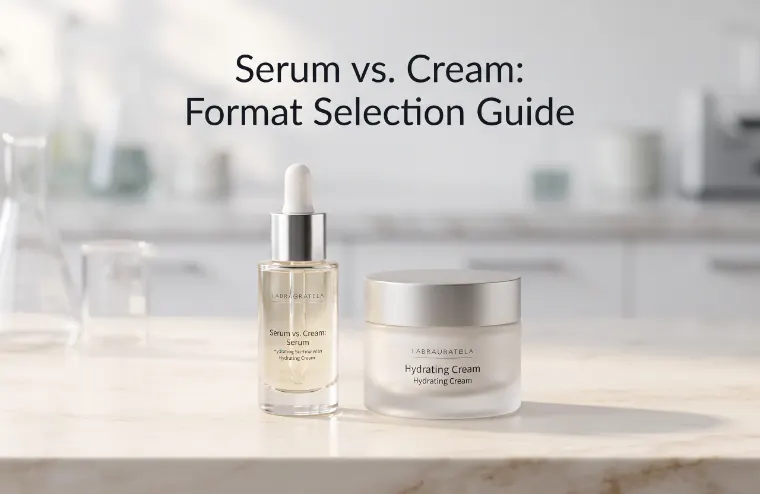
Format selection is compared in more detail in serum vs cream for functional skincare.
Packaging Matters
Packaging can directly influence the formulation strategy.
Depending on the Vitamin C system, brands may consider:
- Opaque packaging
- Airless systems
- Pumps
- Controlled dispensing
- Smaller package sizes
The final packaging should be selected based on the actual formula and stability requirements, as outlined in how to choose skincare packaging.
Vitamin C + Other Active Systems
Vitamin C can be used as part of a broader brightening formulation.
Depending on the final formula, brands may consider complementary systems such as:
- Niacinamide
- Antioxidants
- Hydrating ingredients
- Skin-conditioning ingredients
The compatibility and stability of the complete system should always be evaluated.
What Texture Works Best for a Vitamin C Product?
There is no universal answer.
The ideal texture depends on the intended consumer and product positioning.
Lightweight Serum
Suitable for:
- DTC
- Daily use
- Layering
Rich Cream
Suitable for:
- Premium care
- Daily conditioning
- Night routines
Mask
Suitable for:
- Treatment-oriented positioning
- Intensive skincare routines
Common Vitamin C Product Development Mistakes
Choosing the Ingredient Before the Product Concept
Start with the desired product, then select the most appropriate Vitamin C approach.
Ignoring Packaging
Formula stability and packaging should be considered together.
Using Too Many Actives
More ingredients do not automatically create a better product.
Making Broad Claims
Claims should reflect the actual formulation and target-market requirements.
How Brands Should Brief an OEM
Provide:
This allows the formulation team to develop a clearer starting point.
Vitamin C for Brightening Product Lines
Vitamin C can become a hero active within a broader brightening range.
For example:
This creates a more complete portfolio rather than relying on one product. The relevant range is grouped under Pigment & Brightening.
How Elythra Beauty Approaches Vitamin C Product Development
Vitamin C product development can be structured around:
The final formulation should be developed according to the intended product concept and target market. Existing brightening formats include Glutathione Brightening Serum and Advanced Brightening Serum.
Final Takeaway
A successful Vitamin C product is a combination of:
The key is not simply choosing “Vitamin C.”
It is choosing the right Vitamin C approach for the product you want to build. You can review the broader range in our product portfolio.
Ready to Develop Your Skincare Line?
Share your product concept, target market and estimated quantity. Our team reviews your brief and comes back with a formulation and production proposal.