
How to Develop a Skincare Product for the US Market
Developing a skincare product for the US market requires more than selecting a formula and putting a brand name on the packaging.
A successful product development project needs to connect:
For overseas brands, working with an experienced OEM/ODM partner can also help bring these considerations into the development process earlier.
This guide explains the major steps involved in developing skincare products for the US market.
Important: U.S. regulatory requirements depend on the finished product, ingredients, claims, intended use and responsible parties. This article provides a product-development overview, not legal or regulatory advice.
1. Start With Your Product Concept
Before discussing formula development, define what you are actually trying to launch.
A useful product brief should include:
- Product category
- Product format
- Target consumer
- Primary skin concern
- Intended use
- Target price positioning
- Sales channel
- Target launch date
- Benchmark products
- Preferred ingredients
For example, instead of saying:
“I want a brightening product.”
A stronger brief would be:
“We are developing a lightweight brightening serum for a DTC skincare brand targeting consumers concerned about uneven-looking skin tone and visible dark spots.”
The second version gives an R&D team a much clearer development direction.
2. Define Your Target Consumer
The same ingredient can be used in very different products depending on the target consumer.
Consider:
Skin Concern
Brightening?
Acne-prone skin?
Firming?
Barrier-focused care?
Daily cleansing?
Consumer Profile
Age group, lifestyle, product expectations and purchasing behavior can all influence formulation and packaging decisions.
Product Positioning
Is the product positioned as:
- Mass market
- Premium
- Professional
- Clinical-inspired
- DTC
- Specialty skincare?
Sales Channel
A product developed for Amazon or DTC may have different packaging and communication requirements from one developed for professional skincare channels.
3. Choose the Product Format
Product format influences both formula development and packaging.
Common formats include:
- Serums
- Creams
- Lotions
- Cleansers
- Masks
- Shampoos
- Ampoules
- Specialty treatments
For example, a brightening concept might be developed as a serum, cream, mask or combination line.
The best format depends on the intended consumer experience, formulation strategy, packaging and commercial positioning. Format also shapes how the wider OEM/ODM development process is planned, including packaging and production.
4. Develop the Formula
Once the product concept is clear, the development team can determine the appropriate formulation direction.
Depending on the project, this may involve:
Existing Formula
Start with a developed formula and adapt selected characteristics.
Customized Formula
Modify the formula around your preferred ingredients, texture or positioning.
Benchmark Development
Use an existing product as a reference for development.
New Product Development
Create a new formulation concept from the beginning.
The final formulation should be assessed for stability, safety, compatibility, performance and the requirements of the destination market. The spectrum between adapting an established formula and developing a fully custom one is compared in our private label vs custom ODM guide.
5. Consider U.S. Regulatory Requirements Early
This is one of the most important parts of U.S. product development.
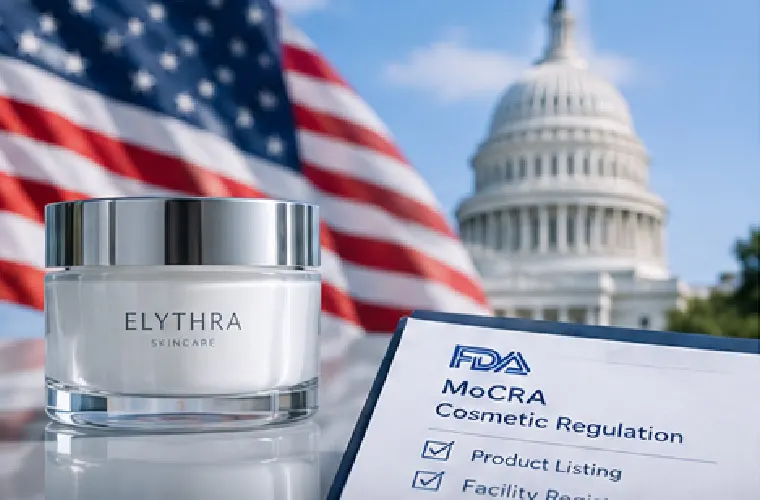
Under the Modernization of Cosmetics Regulation Act of 2022, FDA has new authorities and requirements relating to cosmetic facility registration and product listing. Cosmetic facilities that are required to register generally must renew registration every two years, while the responsible person for each marketed cosmetic product is responsible for product listing and annual updates. Certain small-business exemptions exist, subject to statutory conditions.1
Importantly, FDA cosmetic facility registration or product listing is not the same as FDA approval. FDA explicitly states that registration and listing are not an approval program and that it does not issue certificates proving cosmetic registration or listing.1
This distinction matters when evaluating suppliers and preparing product claims.
6. Review Product Claims Carefully
Product claims should be considered during formulation development, not only after the formula is finished.
For example:
Cosmetic-Oriented Positioning
Helps improve the appearance of uneven skin tone.
Higher-Risk Therapeutic Positioning
Treats melasma.
The difference can be significant.
FDA states that cosmetic labeling claims must be truthful and not misleading. It also explains that claims intended to treat or prevent disease, or affect the structure or function of the body, can cause a product to be regulated as a drug rather than solely as a cosmetic.2
This is particularly important for products positioned around:
- Acne
- Inflammation
- Hair growth
- Wrinkles
- Pigmentation disorders
- Post-procedure recovery
- Medical or therapeutic use
The final product positioning should therefore be reviewed against the actual formulation and intended use.
7. Pay Attention to Sunscreen Products
Sunscreen requires additional attention in the United States because sunscreens are regulated under an OTC drug framework rather than being treated simply as ordinary cosmetics.
FDA’s current sunscreen requirements and active-ingredient framework can change over time. For example, in 2026 FDA issued actions involving sunscreen active ingredients and updated its OTC sunscreen regulatory framework.3
Therefore, a sunscreen project should be evaluated separately from an ordinary skincare project.
Do not assume that a sunscreen formula developed for another market can simply be relabeled and sold in the United States.
8. Plan Packaging and Labeling
Packaging is part of product development, not just a design exercise.
Before final artwork, review:
- Product name
- Net quantity
- Ingredient declaration
- Responsible person information
- Directions
- Warnings where applicable
- Contact information where required
- Product claims
- Packaging material
- Product compatibility
For products marketed under MoCRA, FDA’s product-listing process includes information such as the responsible person, product name as it appears on the label and product category information.4
For this reason, product artwork should be finalized only after the applicable regulatory and labeling requirements have been reviewed.
9. Sampling and Testing
A product should be evaluated before bulk production.
Depending on the project, testing and evaluation may include:
- Formula stability
- Packaging compatibility
- Microbiological quality
- Physical appearance
- Texture
- Odor
- Sensory experience
- Other tests appropriate to the product
The testing program should match the formula, product format and intended market.
10. Pilot Production
Pilot production bridges the gap between laboratory development and commercial manufacturing.
It can help evaluate:
- Production process
- Filling
- Packaging performance
- Batch consistency
- Manufacturing feasibility
- Final product appearance
This step is especially useful when developing customized formulas or complex packaging.
11. Mass Production
After the formula, packaging and specifications are approved, the project can move into commercial production.
A professional OEM/ODM workflow should include appropriate quality-control procedures covering:
The exact quality-control system should be defined according to the manufacturer’s capabilities and the project’s requirements.
12. What Should a U.S. Brand Prepare Before Contacting an OEM?
A well-prepared project brief can significantly improve communication.
Prepare:
- Product Concept
- Target Consumer
- Target Market
- Product Format
- Benchmark Product
- Preferred Ingredients
- Target Price
- Expected MOQ
- Launch Timeline
- Packaging Preference
The more clearly these requirements are defined, the easier it is for an OEM/ODM partner to recommend an appropriate development path. Target quantity is one of those requirements – our skincare OEM MOQ guide explains how to approach it.
Developing a US-Market Product With Elythra Beauty
Elythra Beauty supports product development for brands targeting the United States, from established formula concepts to customized OEM/ODM projects.
The development process can include:
The appropriate regulatory pathway depends on the finished product and final claims.
Final Takeaway
Developing skincare for the U.S. market is not simply about finding a popular ingredient.
A stronger approach considers the entire product lifecycle:
When these elements are considered early, brands can reduce avoidable changes later in the project. For a U.S.-market project you can request a project-specific quote and review our OEM/ODM development services.
References
- U.S. Food and Drug Administration — Registration & Listing of Cosmetic Product Facilities and Products. fda.gov/cosmetics/registration-listing-cosmetic-product-facilities-and-products
- U.S. Food and Drug Administration — Cosmetics Labeling Claims. fda.gov/cosmetics/cosmetics-labeling/cosmetics-labeling-claims
- U.S. Food and Drug Administration — Questions and Answers: FDA’s regulatory actions on over-the-counter sunscreen. fda.gov/drugs/understanding-over-counter-medicines/…-over-counter-sunscreen
- U.S. Food and Drug Administration — Form FDA 5067 – Cosmetic Product Listing. fda.gov/cosmetics/registration-listing-cosmetic-product-facilities-and-products/form-fda-5067-cosmetic-product-listing
Ready to Develop Your Skincare Line?
Share your product concept, target market and estimated quantity. Our team reviews your brief and comes back with a formulation and production proposal.