
Skincare Product Development Timeline: From Product Brief to Mass Production

“How long does it take to launch a skincare product?”
This is one of the most important questions for any beauty brand.
The answer depends on the product.
An established formula with standard packaging may move through development more quickly than a custom product requiring multiple formula revisions, benchmark development, testing and custom packaging.
Rather than promising a fixed number of days, it is more useful to understand the complete development process.
The Six Main Stages of Skincare Product Development
A typical product-development workflow can be organized into:
Each project can move at a different pace depending on formula complexity, packaging and market requirements.
Understanding how this workflow operates inside a factory is useful before requesting a schedule. Our guide to skincare OEM/ODM manufacturing covers the manufacturing side in more detail.
01. Project Brief
Everything starts with a clear product brief.
The brand should define:
- Product concept
- Target consumer
- Target market
- Product format
- Product positioning
- Benchmark
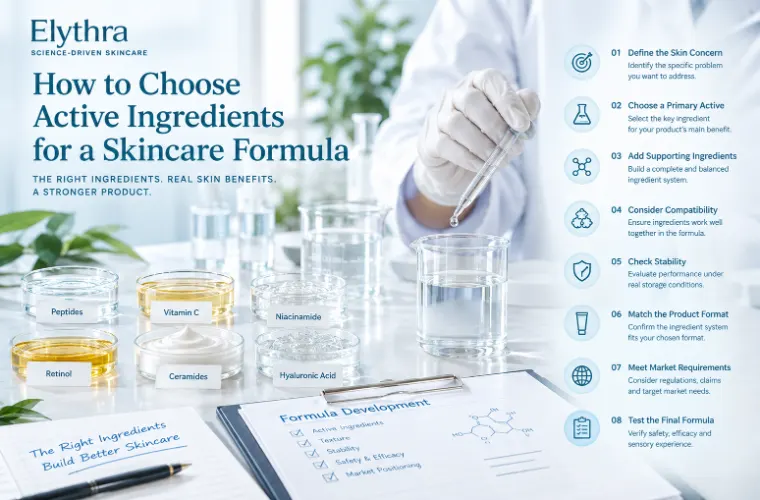
- Preferred ingredients
- MOQ
- Packaging preference
- Launch timeline
A clear project brief can reduce unnecessary back-and-forth during development.
If you are preparing one for the first time, our guide to preparing a skincare product brief lists each field in detail.
02. Formula Development
The next step depends heavily on the starting point.
Established Formula
The brand starts from an existing formula concept.
Modified Formula
Selected characteristics are adjusted.
Custom Formula
A new formulation direction is developed.
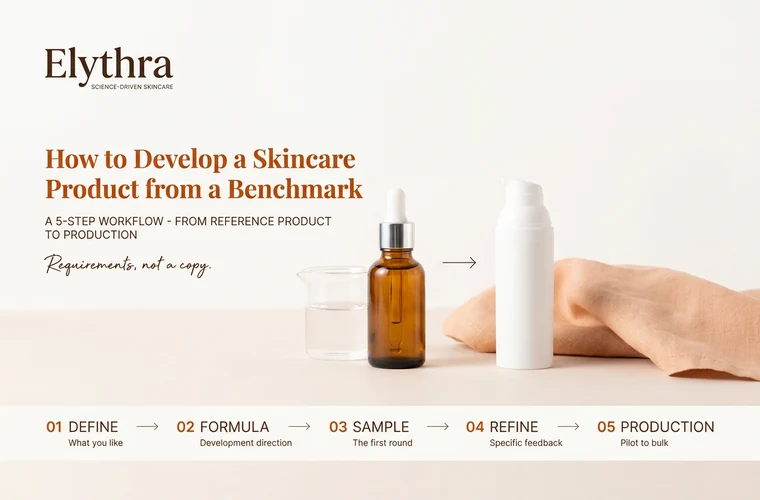
Benchmark Development
An existing product is used as a reference.
Custom development generally requires more formulation work than an established formula. The comparison is covered in stock formula vs custom formula.
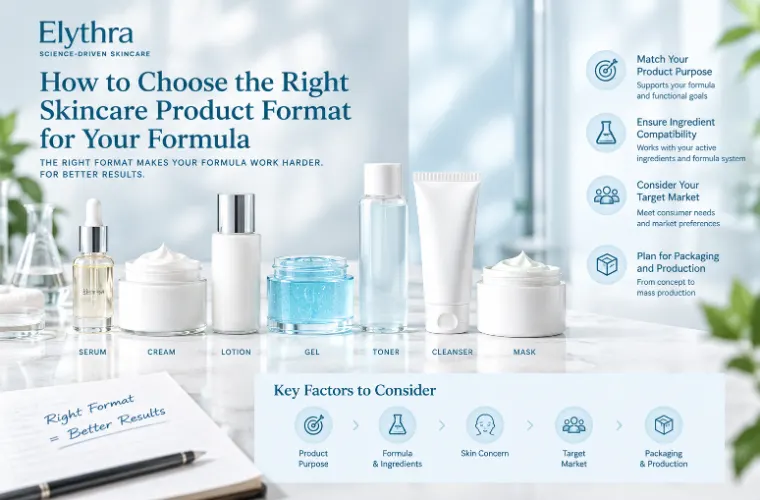
03. Sampling & Testing
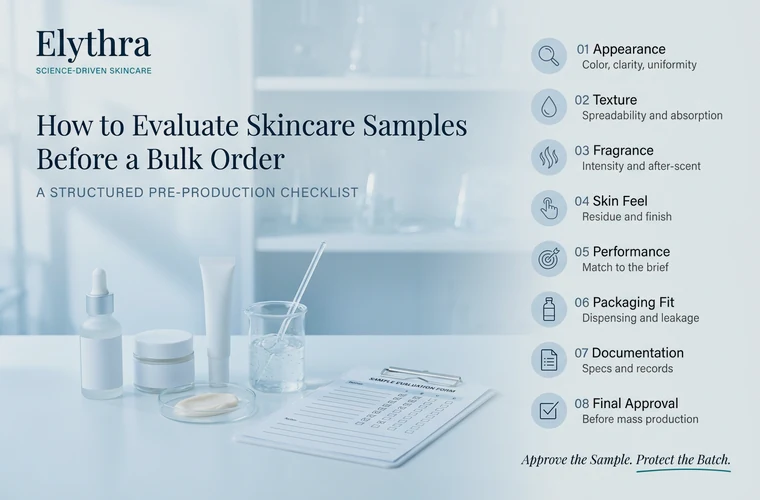
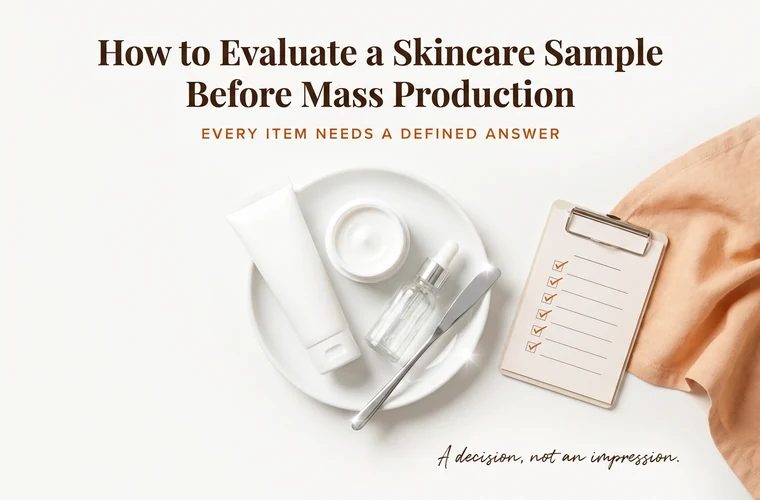
Sampling allows the brand to evaluate the product before commercial production.
A sample review may consider:
- Texture
- Color
- Odor
- Application
- Sensory experience
- Packaging
- Overall product positioning
Depending on the project, more than one sample round may be required.
Testing may also be performed according to the product type and target market.
Why Sample Feedback Matters
A common mistake is to provide feedback that is too general.
For example:
“Please improve the texture.”
A more useful comment is:
“The texture is too rich. Please make it lighter and faster absorbing while maintaining the current moisturizing feel.”
The second version gives the formulator a much clearer direction.
04. Pilot Production
Pilot production is an important bridge between laboratory development and commercial production.
The purpose is to confirm:
- Manufacturing feasibility
- Batch consistency
- Filling
- Packaging
- Production process
- Final appearance
This can help identify issues before mass production begins.
05. Mass Production
After formula and packaging approval, the project moves into commercial production.
A typical workflow includes:
Production scheduling depends on the product, quantity, packaging and factory capacity.
06. Compliance & Delivery
The final stage includes the market-related documentation, packaging information and delivery arrangements appropriate to the product.
Different destinations can have different requirements.
For international projects, the target market should therefore be identified early rather than after production is complete.
What Can Make a Project Take Longer?
Several factors can extend the timeline.
Custom Formula Development
More formulation work generally means more development time.
Multiple Sample Rounds
Every additional round adds review time.
Custom Packaging
Custom components may require additional sourcing and development.
Packaging Artwork
Artwork approval can become a separate critical path.
Testing
Some products require additional evaluation before production.
Market Requirements
Country-specific documentation or labeling requirements may need additional work.
Large Product Lines
Developing several SKUs simultaneously can increase project-management complexity.
How Can Brands Reduce Unnecessary Delays?
Prepare a Complete Product Brief
The more clearly the requirements are defined, the easier the development process can be.
Provide a Benchmark
A reference product can improve communication around texture and sensory experience.
Define the Target Market Early
This avoids changing the product or packaging late in development.
Decide on Packaging Early
Packaging availability can affect production scheduling. The selection criteria are covered in how to choose skincare packaging.
Give Structured Sample Feedback
Clear feedback reduces unnecessary sample revisions.
Single Product vs Product Line Development
A single product and a 6-SKU launch have very different project-management requirements.
For a product line, brands may need to coordinate:
- Multiple formulas
- Packaging components
- Artwork
- Testing
- Sampling
- Production schedules
A product-line roadmap should therefore be created early.
A Practical Product Development Roadmap
Stage 1
Product Brief — Define concept, target market and commercial requirements.
Stage 2
Formula Direction — Select an established formula, modify an existing product or develop a custom formula.
Stage 3
Sample — Evaluate texture, appearance and sensory experience.
Stage 4
Testing — Complete the appropriate product evaluation.
Stage 5
Packaging Approval — Finalize component and artwork decisions.
Stage 6
Pilot Production — Confirm manufacturing feasibility.
Stage 7
Mass Production — Move to commercial production.
Stage 8
Delivery — Complete final documentation and shipment arrangements.
How Elythra Beauty Manages Product Development
Elythra Beauty’s OEM/ODM workflow follows a structured path from:
The actual timeline is determined after the project requirements are understood.
Final Takeaway
A realistic skincare development timeline depends on the product and project scope.
The fastest way to create an efficient project is not necessarily to shorten every stage.
It is to:
Before estimating a schedule, it helps to understand what the project will cost. Our skincare product development cost guide covers the commercial side.
Ready to Develop Your Skincare Line?
Share your product concept, target market and estimated quantity. Our team reviews your brief and comes back with a formulation and production proposal.