How to Audit a Skincare OEM Factory Before Production
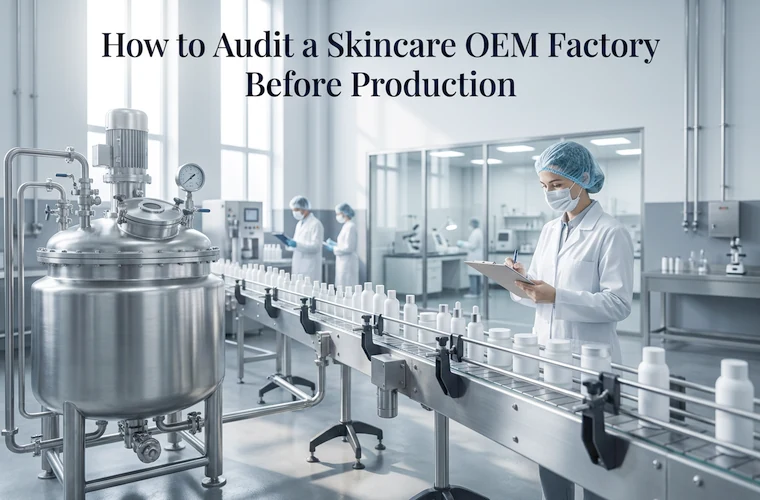
Choosing a skincare OEM manufacturer is only the beginning.
Before moving into commercial production, brands should understand whether the supplier has the manufacturing, formulation, quality-control and project-management capabilities required for their product.
A factory audit provides an opportunity to evaluate these areas systematically. If you have not shortlisted suppliers yet, start with how to choose a skincare OEM manufacturer in China.
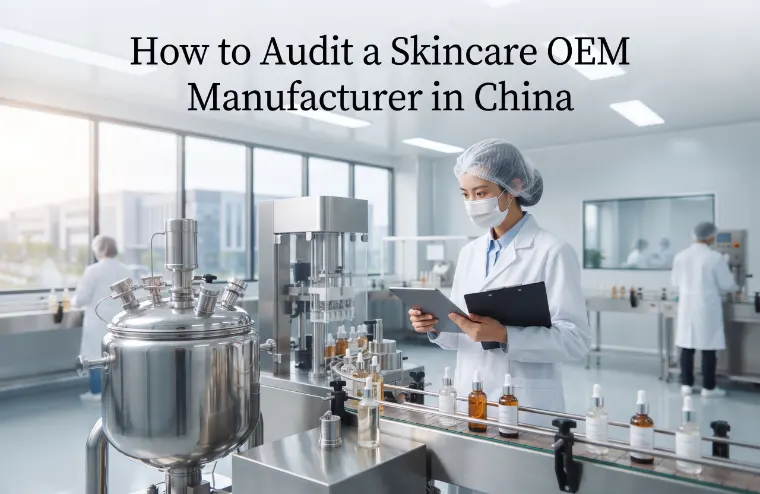
01 Manufacturing Capability
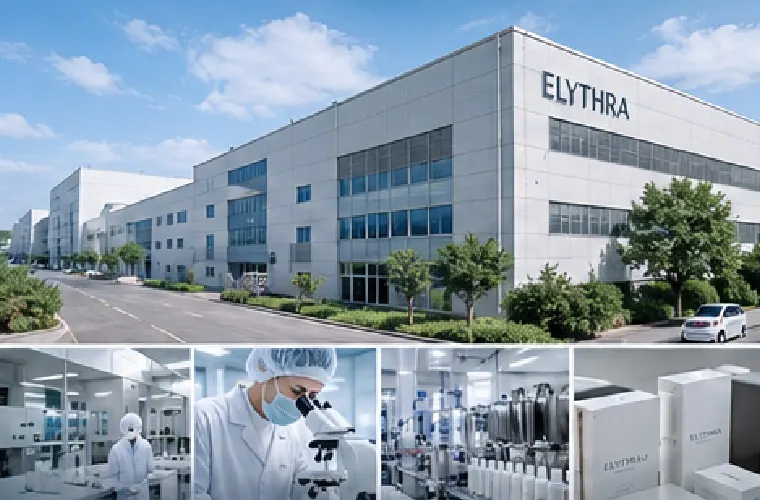
Start with the production environment.
Consider:
- Production areas
- Filling equipment
- Production lines
- Batch capacity
- Product formats supported
- Scale-up capability
The key question is:
Can this manufacturer produce the type of product I am developing at the required scale?
02 R&D and Formulation Capability
A manufacturer may offer production but have limited formulation development capability.
Evaluate whether the supplier can support:
- Formula development
- Formula modification
- Ingredient selection
- Texture development
- Benchmark development
- Stability evaluation
This is particularly important for custom ODM projects.
03 Quality Control
Ask how quality is controlled throughout the production process.
This may include:
Quality should not be treated as a single inspection at the end. The testing programmes behind this are covered in microbial testing and stability testing.
04 Raw Material Management
Ask how raw materials are received, identified, stored and controlled.
Also clarify how material traceability is managed within the production process.
05 Production Traceability
A professional manufacturing process should maintain appropriate batch records and traceability.
Brands should understand:
- How batches are identified
- How production records are maintained
- How finished products are documented
06 Packaging and Filling
Evaluate whether the manufacturer can coordinate:
- Packaging sourcing
- Filling
- Labeling
- Assembly
- Finished-product packing
Integrated coordination can reduce communication between multiple suppliers.
07 MOQ and Production Capacity
MOQ should not be evaluated separately from production capability.
Ask:
- What is the MOQ?
- Does MOQ vary by formula?
- Does packaging have separate MOQ requirements?
- What happens when the order volume increases?
This helps determine whether the supplier can support both initial launch and future growth – see the skincare OEM MOQ guide and skincare OEM pricing in China for the commercial side.
08 Communication and Project Management
A good manufacturing relationship also depends on communication.
Clarify:
- Sample process
- Revision process
- Production approval
- Timeline
- Packaging coordination
- Documentation
- Shipping arrangements
09 Ask for Evidence, Not Just Claims
During an audit, do not rely only on statements such as:
“We have professional quality control.”
Ask to understand how the process actually works.
Look for:
- Documented procedures
- Production records
- Quality-control checkpoints
- Sample approval procedures
- Traceability systems
10 Before Commercial Production
A practical audit sequence is:
Final Thoughts
A factory audit should answer one central question:
Can this manufacturer reliably develop, produce and support my product at the required commercial standard?
For overseas brands sourcing skincare from China, evaluating the complete manufacturing system is more useful than looking only at price.
Ready to Develop Your Skincare Line?
Share your product concept, target market and estimated quantity. Our team reviews your brief and comes back with a formulation and production proposal.