
The Complete Guide to Skincare OEM/ODM Manufacturing
Building a skincare product involves much more than finding a manufacturer.
For a new brand, the process may involve:
For an established brand, the project may involve even more complex requirements, including benchmark development, customized formulations, new packaging and market-specific product considerations.
Understanding the difference between OEM, ODM and private label can help you choose the right development model.
What Is Skincare OEM?
OEM stands for Original Equipment Manufacturing.
In skincare, the term is commonly used to describe manufacturing products for another company’s brand.
Depending on the manufacturer and project structure, OEM services may include:
- Formula manufacturing
- Filling
- Packaging
- Labeling
- Private label production
- Quality control
- Finished-product delivery
The exact scope varies between suppliers.
What Is Skincare ODM?
ODM stands for Original Design Manufacturing.
In skincare development, ODM typically involves a deeper level of product development than simply manufacturing a finished formula.
A brand may work with the manufacturer to develop or customize:
- Formula
- Texture
- Active ingredient system
- Product positioning
- Packaging
- Product specifications
ODM therefore becomes particularly useful when the brand wants more product differentiation.
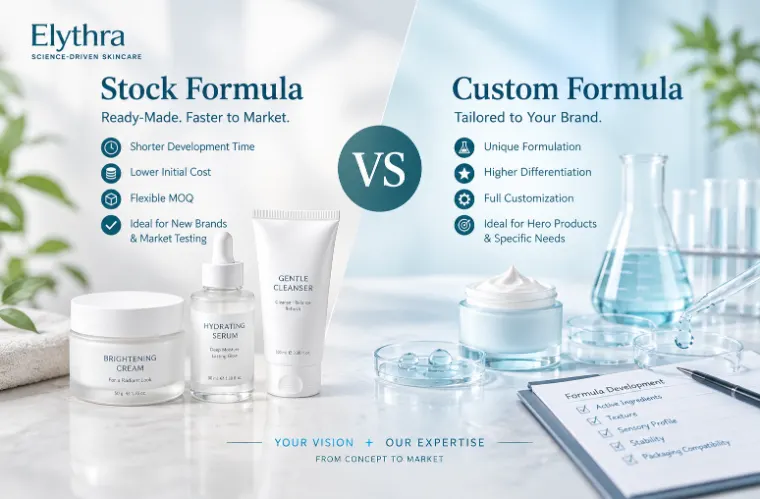
OEM vs ODM
The key difference is the level of product development involved.
| Factor | Private Label / Established Formula | Custom ODM |
|---|---|---|
| Starting Point | Existing formula | Customized development |
| Formula Customization | Selected | Higher |
| Development Speed | Generally faster | Generally longer |
| Product Differentiation | Moderate | Higher potential |
| Brand Input | Lower | Higher |
| Suitable For | New launches / market testing | Specific product concepts |
| Development Complexity | Lower | Higher |
Neither approach is universally better.
The right choice depends on the brand’s product strategy. The practical differences between the two models are set out in our private label vs custom ODM comparison.
Private Label Skincare
Private label can be useful when a brand wants to launch a product without developing a completely new formulation.
A typical project may involve:
This can provide a more straightforward route to market.
For brands testing a new concept, selected established formulas may also provide more flexible starting quantities. How those quantities are determined is explained in our skincare OEM MOQ guide.
Custom Skincare ODM
Custom ODM is more suitable when the brand has specific product requirements.
For example:
“We need a lightweight brightening serum with a specific active system and sensory profile for our premium DTC brand.”
That type of project may require:
- Formula development
- Texture adjustments
- Benchmark evaluation
- Stability testing
- Packaging compatibility
- Product positioning review
Custom ODM is therefore a development process rather than simply a manufacturing order.
The Skincare OEM/ODM Development Process
Step 1 — Project Brief
The project starts with an understanding of:
- Product concept
- Target consumer
- Target market
- Product format
- Product positioning
- MOQ
- Launch timeline
- Packaging requirements
Step 2 — Formula Development
The manufacturer evaluates the formulation direction.
Depending on the project, this may involve:
- Existing formula selection
- Formula modification
- New formulation
- Benchmark development
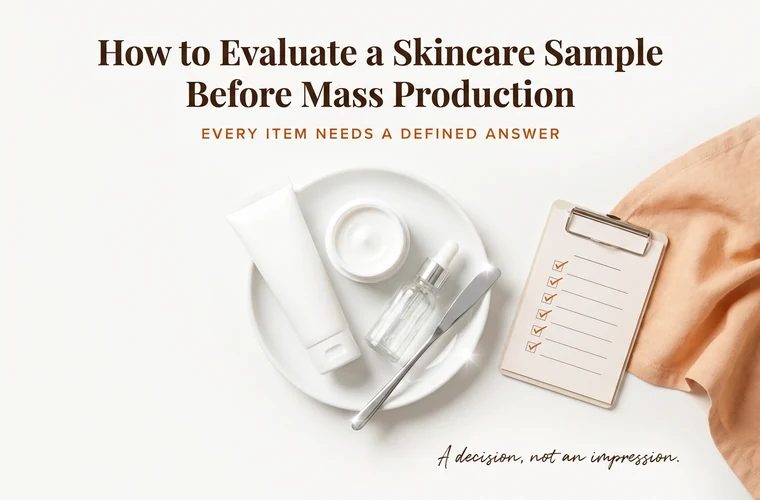
Step 3 — Sampling & Testing
Samples are prepared for evaluation.
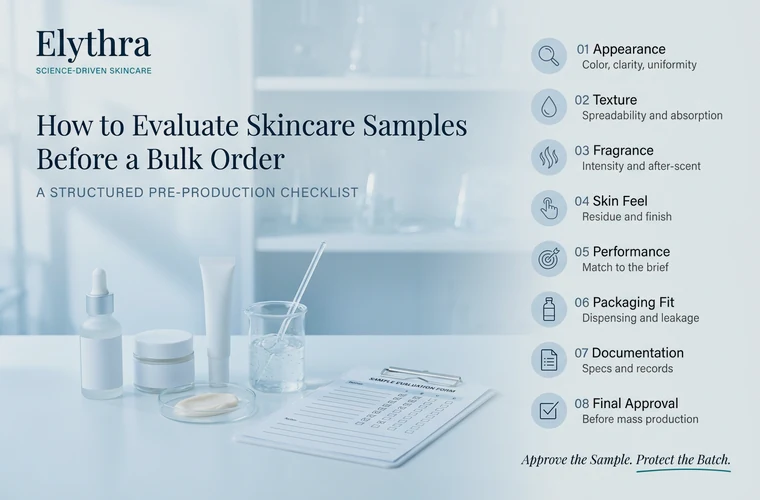
The brand reviews:
- Texture
- Appearance
- Odor
- Sensory experience
- Product performance
- Packaging compatibility
The formula may go through multiple rounds of adjustment.
Step 4 — Pilot Production
Pilot production helps confirm whether the approved formula can be transferred effectively to commercial manufacturing.
This stage can identify production or packaging issues before larger-scale manufacturing.
Step 5 — Mass Production
Once specifications are approved, production moves to commercial scale.
This typically includes:
Step 6 — Compliance & Delivery
The final stage involves the documentation, labeling and delivery requirements relevant to the product and target market.
The specific requirements depend on the destination market and product type.
How Long Does Skincare Product Development Take?
There is no single timeline for every product.
A simple established formula project may move faster than a customized formulation requiring multiple rounds of development and testing.
Timing can be influenced by:
- Formula complexity
- Number of sample rounds
- Testing requirements
- Packaging development
- Packaging availability
- Artwork approval
- MOQ
- Production scheduling
For this reason, a realistic project timeline should be created after the product requirements are defined.
How Does MOQ Fit Into OEM/ODM?
MOQ is connected to:
A private-label product using an established formula and standard packaging may have a different MOQ from a custom formula with customized packaging.
MOQ should therefore be discussed together with the overall project rather than treated as an isolated number. It also feeds directly into project economics – see our skincare product development cost guide.
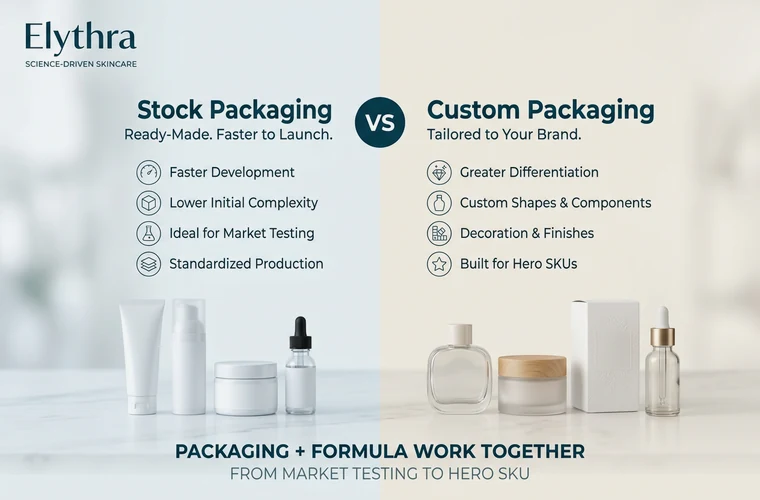
How Does Packaging Fit Into Product Development?
Packaging affects more than appearance.
It can influence:
- Formula compatibility
- Filling process
- Product protection
- Shelf presentation
- Shipping
- Production MOQ
- Cost
For example, a lightweight serum may require a different packaging solution from a cream or shampoo.
Good product development considers formula and packaging together. Packaging coordination is also one of the areas to verify when you choose a skincare OEM manufacturer in China.
What Should You Look for in a Skincare OEM Manufacturer?
Before selecting a supplier, evaluate:
R&D Capability
Can they develop or customize formulas?
Manufacturing Capability
Do they have appropriate production capacity?
Quality Control
What quality-control procedures are used?
Packaging Support
Can they coordinate packaging components?
Communication
Can they manage the project clearly?
Market Support
Can they discuss the requirements of your target market?
Scalability
Can they support your project as production volumes increase?
How to Start Your First OEM/ODM Project
Before contacting a manufacturer, prepare:
- Product Concept
- Target Market
- Product Format
- Target Consumer
- Benchmark
- Preferred Ingredients
- Target Quantity
- Packaging Preferences
- Expected Launch Date
This gives the manufacturer enough context to recommend an appropriate development path. Market-specific requirements, such as those for the United States, are covered in our U.S. market development guide.
Elythra Beauty’s OEM/ODM Approach
Elythra Beauty supports:
- Private Label
- Custom ODM
- Product Line Development
- Benchmark-Based Development
The current product portfolio contains 400 mature formulas across 6 solution categories, allowing brands to start from an existing product concept or build a broader product line around related skincare needs.
The goal is not simply to manufacture a product.
It is to help brands move from:
Final Takeaway
Skincare OEM/ODM manufacturing works best when the manufacturer is treated as a development partner rather than only a production supplier.
The key is to align:
before mass production begins. You can review our OEM/ODM development approach or request a project-specific quote to start a project.
Ready to Develop Your Skincare Line?
Share your product concept, target market and estimated quantity. Our team reviews your brief and comes back with a formulation and production proposal.